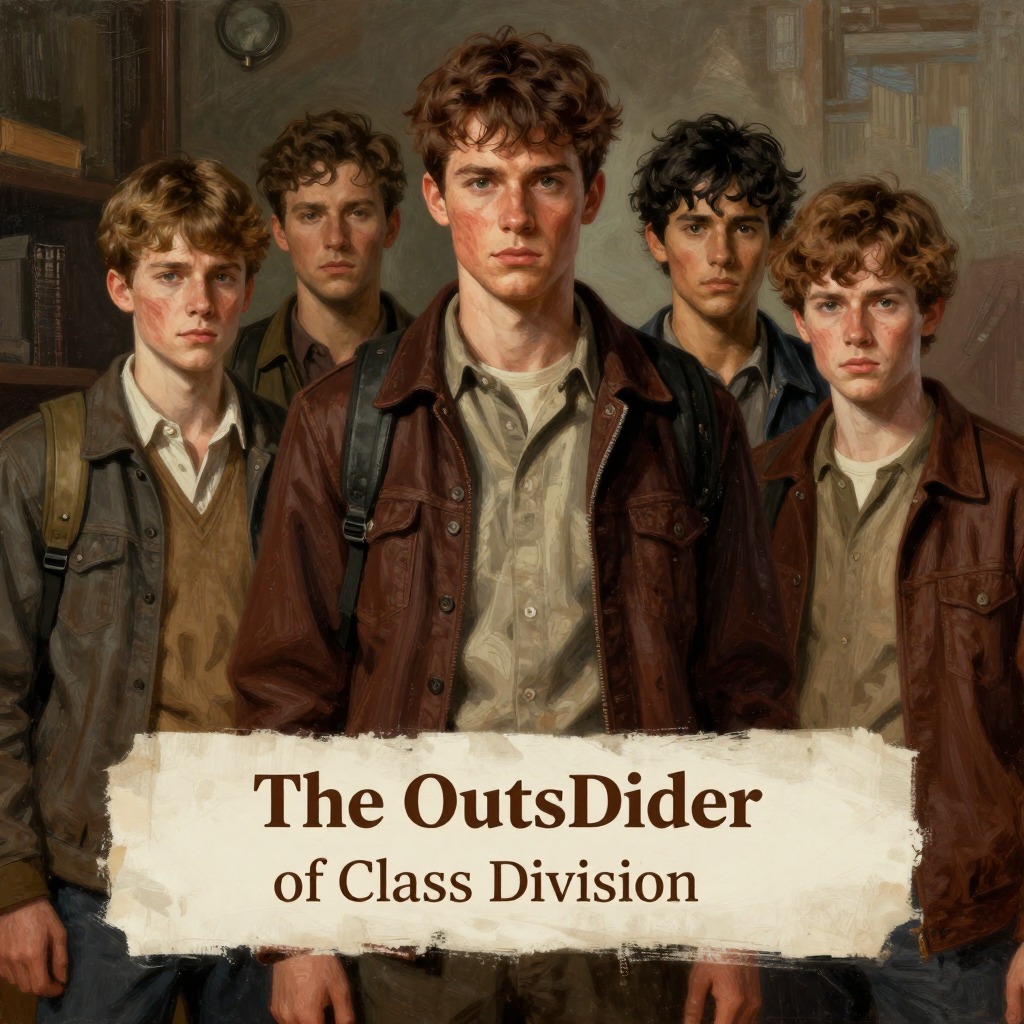
Things are rough all over
The phrase "Things are rough all over" is a key thematic statement in S. E. Hinton's The Outsiders, first spoken by Cherry Valance to Ponyboy Curtis. It serves as a crucial moment of cross-class understanding, challenging Ponyboy's initial belief that only greasers suffer and forcing him to recognize that the Socs, despite their wealth and privilege, also face their own forms of pain, pressure, and emptiness. This expression becomes a touchstone for Ponyboy's evolving perspective on the social divide that structures his world.
Origin and Context
The phrase emerges during a conversation at the Nightly Double drive-in, after Ponyboy has just finished telling Cherry the story of Johnny Cade's brutal beating by four Socs. Ponyboy, still shaken by the memory, is startled to find Cherry as white as a sheet. She insists, "All Socs aren't like that," and draws a parallel: "That's like saying all you greasers are like Dallas Winston." When Ponyboy digests this, Cherry no longer looks sick, only sad. She tells him, "I'll bet you think the Socs have it made. The rich kids, the West-side Socs. I'll tell you something, Ponyboy, and it may come as a surprise. We have troubles you've never even heard of. You want to know something?" She looks him straight in the eye and delivers the line: "Things are rough all over." Ponyboy responds, "I believe you." This exchange is a radical departure from the usual hostility between greasers and Socs; it is a moment of genuine, if fragile, connection across the class line.
Meaning and Thematic Weight
Cherry's statement directly contradicts Ponyboy's earlier, deeply held conviction that the Socs have everything—good grades, good cars, good girls, madras and Mustangs and Corvairs—and therefore nothing to worry about. He had thought, "Man, if I had worries like that I'd consider myself lucky." Cherry's revelation forces him to reconsider. She explains that the Socs are "sophisticated—cool to the point of not feeling anything. Nothing is real with us." She describes their lives as a "rat race," always going and never asking where, always searching for something to satisfy them and never finding it. This emptiness, this inability to feel, is presented as a form of suffering as real as the greasers' poverty and violence. The phrase thus encapsulates the novel's central argument: that social class inflicts different but equally painful wounds on both sides of the divide.
Recurrence and Ponyboy's Growth
The phrase echoes in Ponyboy's mind as the story progresses, becoming a lens through which he reinterprets his world. After a conversation with Randy Adderson, Bob Sheldon's best friend, Ponyboy reflects, "I remembered Cherry's voice: Things are rough all over. I knew then what she meant." Randy, a Soc, confesses his own pain and confusion, revealing that Bob's parents spoiled him rotten and never said no, and that Bob was "trying to make someone say 'No'"—a cry for limits that was never answered. Ponyboy sees that Randy is "already old," like Dallas Winston, and that there is "pain in his eyes." This recognition leads Ponyboy to a new understanding: "Socs were just guys after all. Things were rough all over, but it was better that way. That way you could tell the other guy was human too." The phrase thus becomes a tool for empathy, allowing Ponyboy to see beyond the surface of wealth and privilege to the shared humanity beneath.
Significance in the Novel's Structure
"Things are rough all over" is not merely a passing remark; it is a structural pivot in Ponyboy's character arc. The novel opens with Ponyboy's narrow, embittered view of the Socs as privileged tormentors. Cherry's statement plants a seed of doubt. As Ponyboy encounters Randy's grief, witnesses the emptiness behind the Socs' cool facade, and ultimately grapples with the deaths of Johnny and Dally, the phrase gains cumulative weight. It prepares him for the novel's final, hard-won insight: that the world is full of suffering, but also of beauty and connection. The phrase is a call to look past labels and see the individual, a lesson Ponyboy carries into his decision to write his story, beginning with the same words that opened the novel itself.